
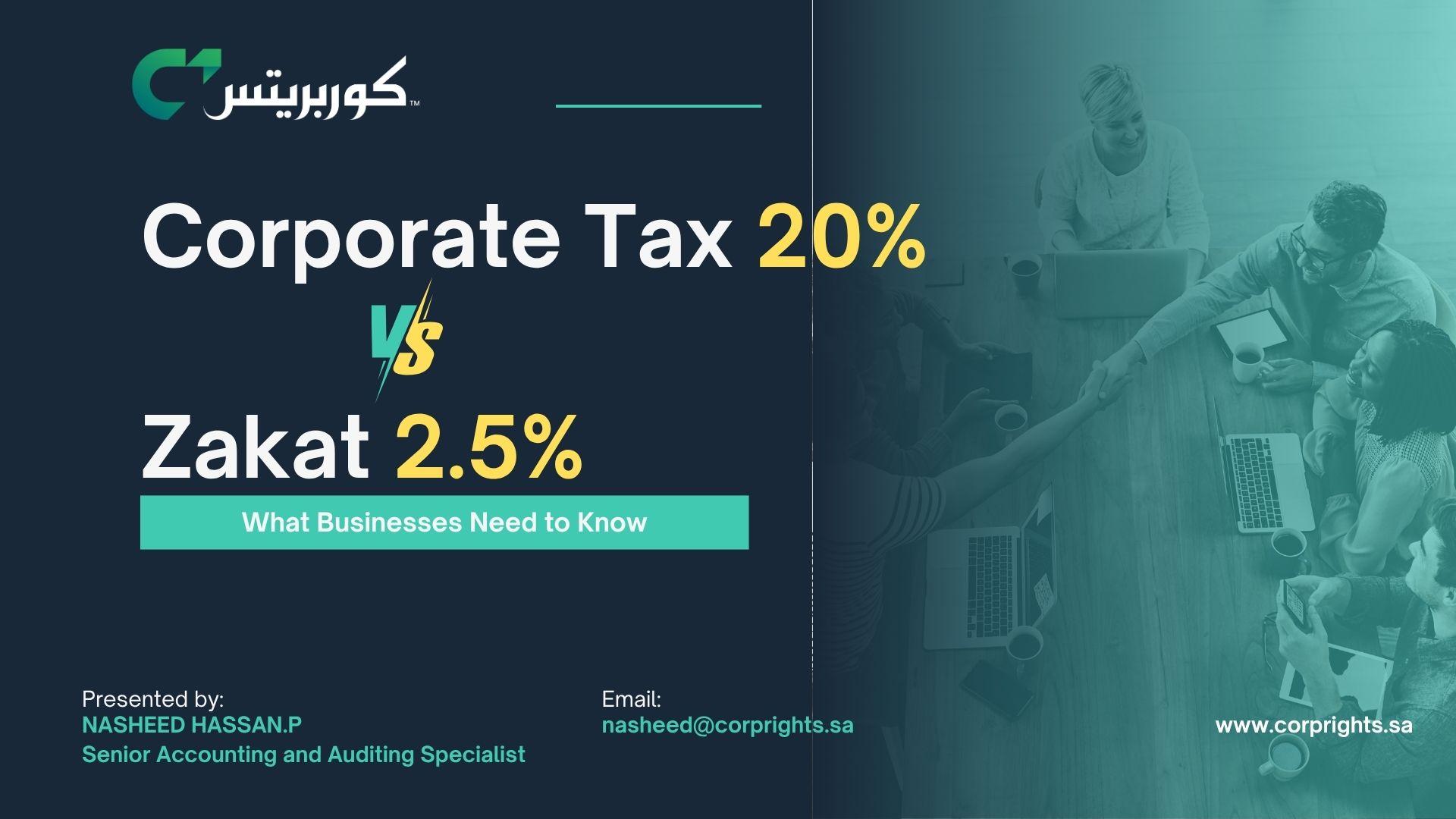
Saudi Arabia’s tax system is unique. Unlike many countries that apply a single corporate tax rate to all businesses, the Kingdom has a dual system: Corporate Income Tax (CIT) at 20% for foreign-owned businesses. Zakat at 2.5% for Saudi and GCC-owned companies. If you’re running a business in Saudi Arabia—or planning to invest—it’s important to understand how these two systems work and how they impact your bottom line. make a poster for it
Corporate Income Tax applies to foreign investors and non-GCC shareholders in Saudi companies.
• Flat rate: 20% on net taxable profits.
• Who pays it? Branches of foreign companies and foreign ownership portions in joint ventures.
• Good news: Ordinary business expenses (like salaries, rent, and depreciation) can be deducted before calculating tax.
In short, foreign investors pay tax on profits, much like in other international markets.

Zakat, on the other hand, applies to Saudi and GCC nationals. Unlike corporate tax, Zakat is based on Shari’ah principles and is considered a religious obligation. • Rate: 2.5% annually. • Who pays it? Saudi and GCC-owned companies, or the Saudi/GCC share in mixed companies. • Calculation: Based not only on profits, but also on equity, reserves, and certain liabilities. So, while the percentage is much lower than corporate tax, the Zakat base can sometimes be broader than just net profit.
In joint ventures, both rules apply: The Saudi/GCC share is subject to Zakat at 2.5%. The foreign share is subject to Corporate Tax at 20%. Example: If a company earns SAR 10 million in profit with 60% Saudi and 40% foreign ownership: • Zakat is applied on the 60% share. • Corporate Tax is applied on the 40% share.
This dual system creates different financial outcomes depending on ownership: Foreign-owned companies: Higher effective tax burden due to the 20% corporate tax. Saudi-owned companies: Lower percentage (2.5%), but applied on a broader base. Mixed companies: Need to carefully calculate and report ownership splits. Both Zakat and CIT are administered by ZATCA, so compliance is key. Proper planning can help businesses stay compliant and optimize their tax liability.
Saudi Arabia’s approach to corporate taxation reflects a balance between international standards and Islamic principles. Whether you’re a foreign investor or a Saudi entrepreneur, knowing the difference between 20% Corporate Tax and 2.5% Zakat is essential. By understanding which system applies to your business, you can plan ahead, avoid surprises, and make informed financial decisions in the Kingdom’s growing market
NASHEED HASSAN.P Senior Accounting and Auditing Specialist
nasheed@corprights.sa +966 55 001 7302
Share

Business setup in Saudi Arabia for Indians in 2026: learn about MISA registration, company formation, CR, VAT, costs, documents, and compliance requirements.

Learn how NRIs in Saudi Arabia can use the India-Saudi DTAA to avoid double taxation, claim tax relief, and plan finances smarter. Full guide inside.