

Planning to start a business in Saudi Arabia from India?
Saudi Arabia has become an increasingly attractive market for Indian entrepreneurs looking to expand into the GCC. Whether you are exploring business setup in Saudi Arabia for the first time or comparing it with other Gulf markets, this guide gives you a clear picture of what the process actually involves.
From professional services and trading to technology, construction, logistics, consulting and hospitality, opportunities exist across a wide range of sectors.
But starting a company in Saudi Arabia as a foreign investor involves more than registering a trade name and opening a bank account. You need to understand the investment rules, choose the right business activity and legal structure, complete the required MISA registration, obtain your Commercial Registration, and then handle tax compliance, employment and operational compliance.
This guide explains how Indian entrepreneurs can set up a business in Saudi Arabia in 2026, what the process involves, which documents may be required, and what you should consider before investing.
Planning to start your Saudi business?
Corprights helps foreign investors with business setup in Saudi Arabia, MISA registration, Commercial Registration, tax compliance, PRO services and post-incorporation support in Saudi Arabia.
Book a free strategy callCan an Indian Citizen Start a Business in Saudi Arabia?
Yes, Indian entrepreneurs can establish businesses in Saudi Arabia, subject to the rules and requirements applicable to their chosen business activity.
Saudi Arabia’s updated Investment Law provides a framework for foreign investors and aims to facilitate investment, protect investor rights and provide equal treatment between local and foreign investors, subject to applicable laws and restrictions.
The current Investment Law states that a foreign investor must register with the Ministry of Investment before engaging in investment activities, subject to applicable exceptions.
Whether you can fully own your business, need additional approvals, or require a Saudi partner depends largely on the business activity and applicable regulations. MISA confirms that some activities may require a local partner while others can be undertaken without one.
That is why choosing the correct activity before starting the incorporation process is one of the most important decisions for an Indian investor.
Why Should Indian Entrepreneurs Consider Saudi Arabia in 2026?
Saudi Arabia is no longer a market driven only by oil and energy. Under Vision 2030, the Kingdom is expanding sectors such as tourism, technology, logistics, construction, manufacturing, entertainment, healthcare and professional services.
For Indian entrepreneurs, Saudi Arabia can also offer access to a large consumer market and the wider GCC business ecosystem.
Some areas that may offer opportunities include:
- Information technology and software services
- Consulting and professional services
- Construction and contracting
- Engineering services
- Trading and distribution
- Logistics and transportation
- E-commerce
- Hospitality and tourism
- Manufacturing
- Healthcare-related businesses
- Education and training
- Digital and technology businesses
- Marketing and creative services
However, opportunity alone is not enough. Your proposed activity must be checked against the current Saudi regulatory framework before incorporation.
Step-by-Step Process to Set Up a Business in Saudi Arabia as an Indian Entrepreneur
The exact process varies according to your activity, ownership structure and approvals required. In general, an Indian entrepreneur can expect the following stages.
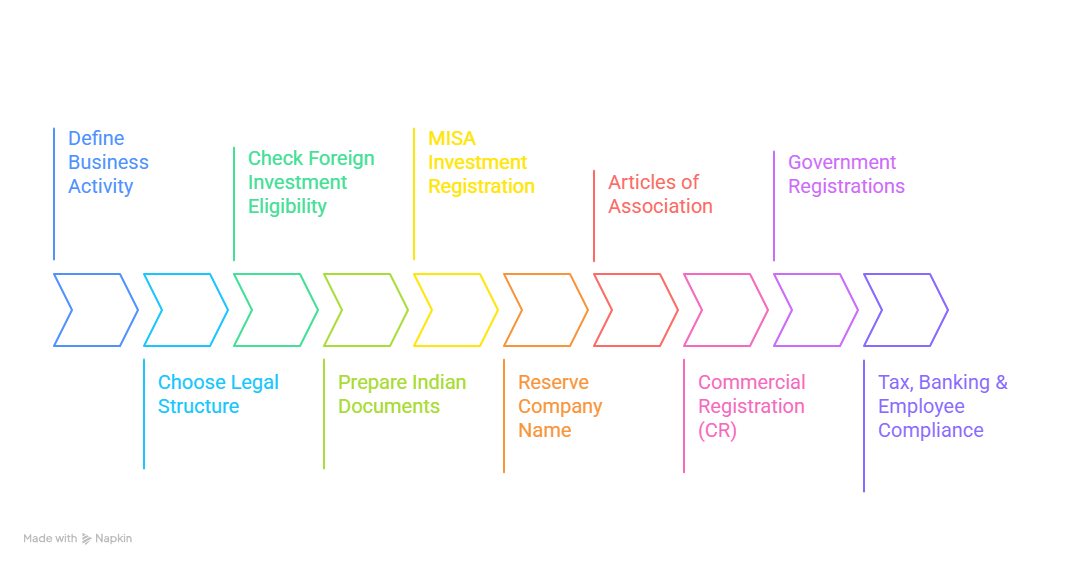
Decide What Business You Want to Start
Before applying for any registration, clearly define your business activity.
For example, there is a significant difference between:
- IT consultancy
- Software development
- General trading
- Import and export
- Construction
- Marketing services
- Management consultancy
- Manufacturing
- E-commerce
- Professional services
The activity affects the licensing route, Commercial Registration, ownership conditions and ongoing compliance requirements.
Do not choose an activity simply because it sounds similar to your Indian company.
Your Saudi activity should accurately reflect the services or products you intend to provide.
Why Activity Selection Matters
An incorrect activity classification can create problems later with:
- Licensing
- Commercial Registration
- Municipality approvals
- Bank account opening
- Employee visas
- Tax registration
- Government contracts
- Saudization requirements
At Corprights, the first stage of the setup process is to understand the investor’s actual business model and identify the appropriate activity and registration route. Corprights currently describes its company-formation process as including business activity identification, MISA category mapping and foreign-ownership eligibility checks.
Choose the Right Legal Structure
Your next decision is the legal structure of the Saudi business.
For many foreign investors, a Limited Liability Company (LLC) can be an appropriate structure, but the best option depends on the nature and scale of the business.
The Saudi Ministry of Commerce provides an electronic service for establishing a limited liability company through the Saudi Business Center. The service covers the company’s Commercial Registration and Articles of Association, along with several related registrations.
Other structures may be relevant depending on the business model. Your decision should consider:
- Number of shareholders
- Ownership requirements
- Business activity
- Capital requirements
- Future expansion plans
- Liability
- Tax and accounting considerations
- Hiring plans
- Investment requirements
Choosing the structure before checking the activity and investment requirements can lead to unnecessary delays.
Check Foreign Investment Eligibility
Foreign investment is regulated in Saudi Arabia, and not every activity follows exactly the same requirements.
The updated Investment Law provides for a list of activities in which foreign investment is prohibited or restricted. MISA’s current Investor Guide also distinguishes activity categories and their specific requirements.
For an Indian entrepreneur, this means you should verify:
- Whether your activity is open to foreign investment
- Whether any ownership restrictions apply
- Whether a local partner is required
- Whether sector-specific approval is necessary
- Whether additional qualifications or licenses are required
This should be completed before committing significant capital to the Saudi operation.
Prepare Your Indian Company and Personal Documents
Foreign investors generally need to provide documentation supporting their identity, business background and proposed investment.
Depending on your structure and circumstances, documents may include:
- Passport copies
- Indian company Commercial Registration or incorporation documents
- Memorandum and Articles of Association
- Board resolution
- Power of Attorney, where applicable
- Audited or financial statements for the foreign company
- Business activity details
- Proposed company information
- Shareholder information
- Other activity-specific documents
The MISA Investor Guide states that investment registration applications can require documents such as a certified foreign company’s Commercial Registration, financial statements for the last fiscal year and activity-specific requirements.
Document Attestation Matters
Documents issued in India may need authentication or attestation through the relevant authorities and Saudi diplomatic channels, depending on the document and procedure.
This is one area where preparing documents incorrectly can cause avoidable delays.
Apply for MISA Investment Registration
Understanding MISA registration is central to any business setup in Saudi Arabia for foreign investors.
For many foreign investors, the next major stage is registration with the Ministry of Investment of Saudi Arabia (MISA).
MISA’s current framework requires foreign investors to register before engaging in investment activities, subject to the applicable rules and exceptions.
MISA states that Investment Registration applications can be submitted electronically and that applicants do not need to visit the Ministry’s headquarters for the application.
What Does MISA Registration Do?
It establishes your foreign investor status and forms an important part of the legal pathway for setting up your Saudi business.
Depending on the activity, you may also need approvals from other authorities.
Important: MISA registration is not the same thing as completing every requirement needed to operate the business. Your company may still need Commercial Registration, municipal or sector-specific licenses, tax registration and other operational registrations.
Need help with MISA and company registration?
Corprights coordinates MISA registration, Commercial Registration, tax, PRO services and post-incorporation support so you do not have to manage every portal alone.
Book a free strategy callReserve Your Company Name
Once the investment pathway is established, the company name can be processed through the relevant Saudi registration system.
The Saudi Business Center provides company establishment and Commercial Registration services.
Your proposed name should comply with Saudi naming rules and should not conflict with existing registered names or protected trademarks.
It is a good idea to prepare several alternatives rather than depending on only one name.
Prepare and Authenticate the Articles of Association
The company’s Articles of Association establish important details about the business, including its ownership, management and operating structure.
The Ministry of Commerce explains that, following company-establishment procedures and partner authentication, the Articles of Association can be issued and the Commercial Registration generated electronically.
The AoA should be prepared carefully because changes later can involve additional procedures and costs.
Obtain the Commercial Registration (CR)
The Commercial Registration (CR) is a critical document for operating a company in Saudi Arabia.
The Ministry of Commerce provides an electronic company-establishment process through the Saudi Business Center. The current LLC service covers recording the Commercial Registration and Articles of Association and connecting several post-registration processes.
Once the CR is issued, your Saudi company has moved from the incorporation stage toward actual operations.
However, obtaining the CR does not mean your compliance obligations are finished.
Register with the Relevant Government Authorities
After incorporation, additional registrations and accounts may be required.
Depending on your company and activities, these can include:
- Zakat, Tax and Customs Authority (ZATCA)
- General Organization for Social Insurance (GOSI)
- Ministry of Human Resources and Social Development
- Qiwa
- Saudi National Address
- Chamber of Commerce
- Municipality or Balady
- Industry-specific authorities
- Customs-related systems
- Other government portals
The Ministry of Commerce’s current company-startup information confirms that company establishment can connect with registrations involving the Ministry of Human Resources and Social Development, ZATCA, GOSI and the national address.
The exact registrations depend on your business activity and operating model.
Complete VAT and Tax Registration
Tax compliance is one of the areas that Indian entrepreneurs should plan for from the beginning.
Businesses carrying out taxable economic activities may need to register with ZATCA for VAT.
As of 2026, the mandatory VAT registration threshold is generally SAR 375,000 in annual taxable supplies, while businesses exceeding SAR 187,500 but below SAR 375,000 may qualify for voluntary registration, subject to the applicable rules.
Your accounting system should be prepared for:
- VAT invoices
- Sales records
- Purchase records
- Tax calculations
- VAT returns
- Supporting documents
- Record retention
Don’t wait until your business starts generating significant revenue before thinking about tax compliance.
Open a Saudi Corporate Bank Account
Once your company documentation is in place, you can proceed with corporate banking.
Banks may request documents such as:
- Commercial Registration
- Articles of Association
- Shareholder information
- Company address
- Identification documents
- MISA-related documentation
- Authorized signatory information
- Business activity information
- Additional compliance documents
Bank requirements can differ, so having your company documents and business information consistent across all registrations is important.
Corprights currently lists corporate bank account coordination and documentation among its company-formation services.
Arrange Visas, Iqama and Employee Requirements
If you plan to personally relocate to Saudi Arabia or employ staff, immigration and employment compliance becomes another important stage.
Depending on the circumstances, this may involve:
- Manager or investor-related residency procedures
- Employee visas
- Work permits
- Iqama
- Qiwa
- Muqeem
- Health insurance
- Employment contracts
- Payroll compliance
The requirements depend on the company’s structure, activity, employee categories and applicable regulations.
Understand Saudization Requirements
One of the biggest mistakes foreign entrepreneurs make is treating Saudization as something to worry about later.
Saudi Arabia has localization policies that can apply to specific professions, sectors and company categories. These requirements can change over time.
For example, in 2026, the Ministry of Human Resources and Social Development (HRSD) introduced a 60% Saudization rate for covered marketing and sales professions.
The implementation began on April 19, 2026, and applies to establishments with three or more workers in the covered professions, subject to the applicable requirements.
There have also been 2026 updates affecting other professions and sectors.
Your hiring plan should be reviewed against the current profession-specific and Nitaqat requirements, rather than relying on information from older articles.
How Much Does It Cost to Start a Business in Saudi Arabia as an Indian?
There is no single fixed cost for starting a business in Saudi Arabia.
The total investment depends on factors such as:
- Business activity
- Legal structure
- Foreign investment requirements
- Government registration fees
- Licensing
- Office requirements
- Professional approvals
- Visa and residency costs
- Employee requirements
- Accounting and tax compliance
- Legal and consulting fees
- Share capital requirements, where applicable
A Better Way to Calculate Your Setup Budget
Instead of asking only:
“How much does company registration cost in Saudi Arabia?”
Indian entrepreneurs should calculate:
Government fees + licensing + office/address costs + professional fees + visas + employee costs + tax/accounting + working capital
That gives you a much more realistic picture of the investment required.
How Long Does It Take to Set Up a Business in Saudi Arabia?
There is no universal timeline because the process depends on:
- Business activity
- Completeness of documents
- Foreign investor registration
- Required approvals
- Company structure
- Document authentication
- Government processing
- Banking procedures
The MISA Investor Guide currently lists an estimated processing time of 10 working days for its investment registration service, subject to complete documentation and applicable requirements.
For this reason, be cautious of anyone promising that every Saudi company can be established within a fixed number of days.
A better approach is to prepare the documentation correctly and identify potential approval issues before submission.
Can I Start a Saudi Business Without Living in Saudi Arabia?
In many cases, foreign investors can begin the incorporation process remotely.
MISA confirms that Investment Registration applications can be submitted electronically without visiting its headquarters. The Ministry of Commerce also provides electronic company-establishment services through the Saudi Business Center.
However, the exact requirements depend on your business structure, shareholders, business activity, documents, authorized representatives, residency status and banking requirements.
Starting the process from India may be possible, but the complete operational setup can involve additional Saudi-side requirements.
Do Indian Entrepreneurs Need a Saudi Partner?
Not necessarily.
The requirement for a local partner depends on the business activity and applicable regulations.
MISA’s current FAQ confirms that some activities require a local partner while others can be carried out without one.
Therefore, you should not assume either of these statements is universally correct:
“Every foreign company needs a Saudi partner.”
Or:
“Every foreigner can own 100% of every business.”
The correct answer depends on the specific activity and current regulatory requirements.
Common Mistakes Indian Entrepreneurs Should Avoid
Starting a company in another country is a major financial decision. A few early mistakes can create expensive problems later.
1. Choosing the Wrong Business Activity
Your registered activity should accurately represent what your company actually does.
2. Using Outdated Information
Saudi regulations are evolving quickly. Requirements that applied several years ago may not apply in 2026.
3. Assuming One Setup Process Works for Every Business
Trading, consulting, technology, construction and regulated activities can have very different requirements.
4. Ignoring Saudization
Hiring requirements should be considered before building your workforce.
5. Treating Tax Registration as an Afterthought
VAT and accounting systems should be planned from the beginning.
6. Preparing Documents Incorrectly
Authentication, corporate documents and financial statements can be important parts of the foreign investment process.
7. Choosing a Location Without Considering the Business Model
Riyadh, Jeddah, Dammam and other Saudi cities can serve different business needs.
8. Focusing Only on Registration Fees
Your actual startup budget includes operational and compliance costs, not just government fees.
Riyadh vs Jeddah: Which Is Better for an Indian Business?
There is no single “best city” for every entrepreneur.
Riyadh
Riyadh can be particularly relevant for:
- Consulting
- Technology
- Government-related business
- Professional services
- Corporate headquarters
- Finance
- B2B services
Jeddah
Jeddah can be attractive for businesses connected to:
- Trading
- Logistics
- Import and export
- Retail
- Tourism
- Hospitality
- Red Sea commercial activity
Eastern Province
Dammam, Al Khobar and surrounding areas may be particularly relevant for:
- Oil and gas
- Industrial services
- Engineering
- Manufacturing
- Energy-related businesses
- B2B contracting
Your location should be selected based on your customers, workforce, operations, suppliers and regulatory requirements rather than simply choosing the most popular city.
Why Work With a Saudi Business Setup Consultant?
A foreign entrepreneur has to coordinate with multiple authorities and systems.
You may need to deal with:
MISA → Ministry of Commerce → ZATCA → GOSI → Qiwa → Chamber of Commerce → Municipality → Banking → Immigration → Other sector-specific authorities
The challenge is not simply knowing the names of these authorities.
The real challenge is knowing what needs to happen, in what order, and which requirements apply to your particular business.
This is where an experienced Saudi business setup consultant can help.
How Corprights Helps Indian Entrepreneurs Set Up in Saudi Arabia
At Corprights, we specialise in business setup in Saudi Arabia for foreign investors, covering the full journey from initial planning to post-incorporation compliance.
Our services can cover the journey from initial planning to post-incorporation compliance, including:
Business Activity & Structure Advisory
We help assess your proposed activity and identify an appropriate setup route.
MISA Registration
Support with foreign investor registration and the required documentation.
Company Incorporation
Assistance with Articles of Association, company registration and Commercial Registration.
Tax & Accounting Support
Support for ZATCA registration, VAT compliance, bookkeeping, accounting and related requirements.
PRO & Government Services
Assistance with government procedures, employee-related services, renewals and documentation.
Post-Incorporation Compliance
Support after incorporation so your company can remain compliant while you focus on operations.
Corprights currently states that its team includes chartered accountants, lawyers and PRO specialists and that it has guided 900+ clients from more than 20 countries through Saudi market entry and related services.
Frequently Asked Questions
Your Saudi Business Journey Starts With the Right Setup
Business setup in Saudi Arabia as an Indian entrepreneur can open the door to one of the GCC’s most important markets.
But the first step should not be rushing into registration.
Start by understanding your business activity, ownership structure, investment requirements, documentation, licensing and compliance obligations.
Once these are clear, the incorporation process becomes much easier to manage.
Ready to Establish Your Business in Saudi Arabia?
Contact Corprights for end-to-end support with company formation, MISA registration, Commercial Registration, tax, PRO services and post-incorporation compliance.
Talk to CorprightsTalk to Corprights at www.corprights.sa or email support@corprights.sa.
Written by: Corprights Saudi Business Setup Team
Reviewed by: Corprights Legal & Compliance Team
Last Updated: August 2026
Regulatory requirements may change. Always verify the latest requirements with the relevant Saudi authorities before making business or investment decisions.
Read more
Business Setup in Saudi Arabia
Explore the full setup journey from licensing and company structures to taxes, visas, and compliance.
Learn moreCompany Formation in Saudi Arabia
See how Commercial Registration and legal structures work for foreign-owned companies.
Learn moreMISA License Saudi Arabia
Understand foreign investment licensing before you file your first application.
Learn moreAccounting Services in Saudi Arabia
Plan VAT, Zakat and your accounting framework before revenue starts.
Learn morePRO Services in Saudi Arabia
Keep licenses, visas and renewals moving after incorporation.
Learn more